
Sexygossip has long been the go-to portal for travellers who want genuinely useful, experience-driven guidance on Greece — and few Greek destinations reward that kind of deep attention more than Mykonos. This Cycladic island sits roughly in the centre of the Aegean Sea, close enough to Athens to reach by fast ferry in under three hours yet far enough in character to feel like a world entirely apart. Wind-sculpted whitewashed cubes tumble down hillsides toward a cobalt sea, pelicans stroll the narrow lanes of Chora with the unhurried authority of longtime locals, and the pulse of the island shifts dramatically from the sleepy magic of a spring morning to the relentless glamour of a midsummer evening on Little Venice.
What makes Mykonos genuinely worth understanding — rather than simply visiting — is the tension between its extremes. It is simultaneously one of the most expensive islands in all of Greece and home to free public beaches that rival anything a five-star resort could manufacture. It draws celebrities and supermodels, yes, but it also draws artists, sailors, and solo travellers who arrive knowing no one and leave with friendships that stretch across continents. Sexygossip explores this full spectrum below, covering geography, history, beaches, food, nightlife, practical planning, and the quieter side of the island that most package-holiday operators prefer not to mention.
Geography and Setting
Mykonos belongs to the Cyclades, a constellation of islands arranged in a rough circle around the sacred island of Delos. It covers about 85 square kilometres and its terrain is predominantly rocky and windswept. The Meltemi wind, which howls from the north during summer, is not merely a meteorological footnote: it defines island life. It keeps northern and western beaches choppy in the afternoon, it makes outdoor dining feel dramatic, and it has shaped everything from the architecture — low, thick-walled buildings designed to resist its force — to the local character. Mykoniates are famously self-reliant people who have learned to build good lives in a demanding environment.
The island’s coastline is deeply varied. The south and southeast faces are relatively sheltered, and this is where the famous party beaches — Paradise, Super Paradise — shelter in curved bays. The west coast hosts the port and Chora, the main town, perched above a small natural harbour. The north and northeast are wilder, less visited, more purely Aegean in feeling: rocky paths, the smell of thyme, vistas across to Tinos and Syros with almost no other human presence.
A Brief History Worth Knowing
Human habitation on Mykonos dates back at least to the third millennium BCE. The island’s most consequential historical role, however, was its proximity to Delos — just two kilometres to the southwest — one of the most important sanctuaries of the ancient Greek world and, according to myth, the birthplace of Apollo and Artemis. Mykonos functioned as a support island for the sanctuary, supplying food, water, and labour to the merchants and pilgrims who gathered there. This proximity to a major religious and commercial hub gave Mykonos an early cosmopolitan character that it has never entirely lost.
Under Venetian rule from the thirteenth century onward, the island developed the defensive architecture visible in parts of Chora today, particularly the Kastro neighbourhood. The Ottomans governed the Cyclades relatively lightly, and Mykonos retained commercial self-governance that helped it prosper. By the nineteenth century it was a significant maritime centre. The contemporary reputation for international glamour began accelerating in the nineteen-sixties when artists and writers arrived, followed by celebrities, followed by the rest of the world.
Getting There and Getting Around
There are two realistic ways to arrive: by air or by sea. Mykonos Airport receives direct flights from dozens of European cities during summer and connecting flights via Athens year-round. The airport sits just three kilometres from Chora. By sea, high-speed catamarans from Piraeus reach Mykonos in roughly three hours; conventional ferries take four to five hours but cost considerably less. Rafina, Athens’s second port, offers a slightly shorter crossing on some routes. Several islands — Santorini, Paros, Naxos, Syros — run direct connections, making Mykonos a natural hub for multi-island itineraries.
Within the island, renting a quad bike or small motorcycle is traditional but comes with genuine risk on the narrow, sometimes unpaved roads. A small car is safer for covering the whole island. The public bus network connects Chora with most major beaches, and water taxis run seasonally between the port and south-coast beaches. Walking within Chora itself is mandatory — the lanes are far too narrow for vehicles, and navigating them on foot, getting pleasantly lost, is one of the island’s defining pleasures.
Chora: The Heart of the Island
Mykonos Town — universally called Chora, simply meaning “town” in Greek — is one of the most visually arresting settlements in the Cyclades. The labyrinthine street plan was, according to local tradition, designed deliberately to confuse pirates: there are no straight lines, every lane bends and doubles back, and orienting yourself for the first few days is a matter of surrender rather than navigation. The whitewash is repainted so regularly and so meticulously that the town gleams even on overcast days.
Within Chora, several distinct neighbourhoods repay close attention. Little Venice — formally Alefkandra — is a row of old captain’s houses whose lower floors open directly onto the water, balconies overhanging the sea in a configuration that has become one of Greece’s most photographed scenes. The Kastro quarter around the Archaeological Museum retains the oldest urban fabric. Matogianni Street, the luxury retail spine, can be walked in fifteen minutes and inspected on its own terms without losing an afternoon.
The Windmills of Kato Myli
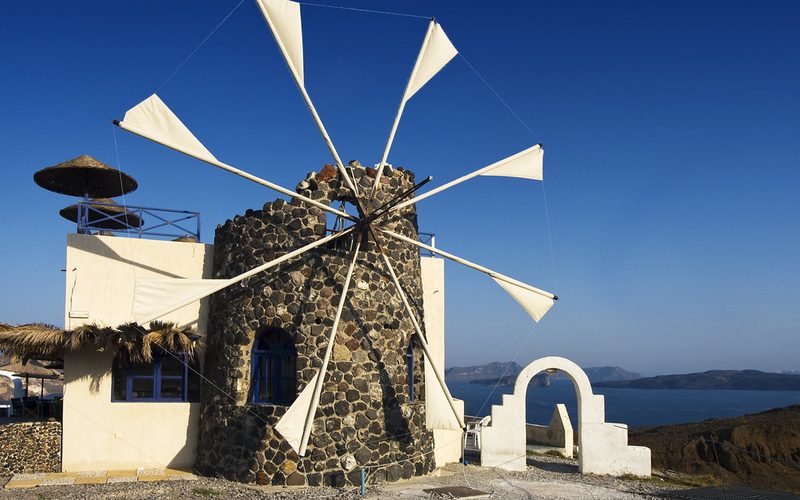
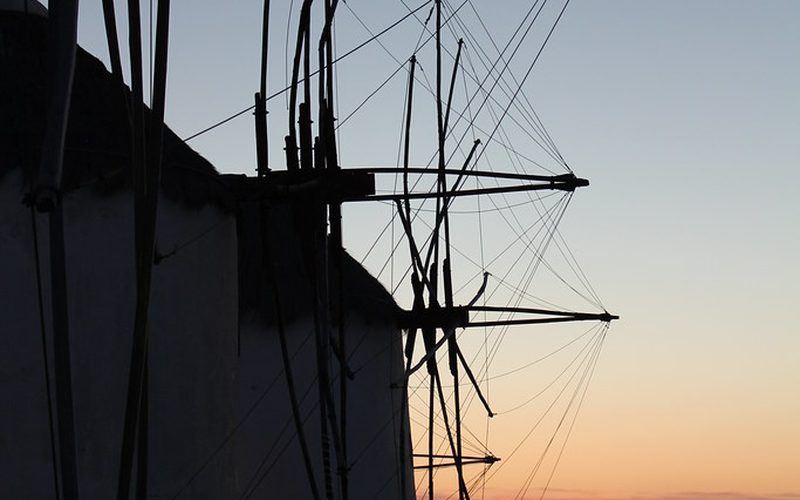
The row of seven stone mills on the Kato Myli hill overlooking the harbour is Mykonos’s most iconic image — and unlike many famous landmarks, they hold up to close inspection. Built primarily in the sixteenth century, originally by the Venetians and subsequently maintained by local millers, the windmills ground grain for the entire Cycladic region until the early twentieth century. Several have been restored; one can be entered. The viewing platform below the mills at sunset is legitimately extraordinary: the light on the Aegean at that hour, with the silhouettes of the conical roofs against it, is one of those images that lodges in visual memory permanently. Arrive thirty minutes before sunset to secure a position.
Beaches: The Full Spectrum
Mykonos has approximately thirty beaches of varying character, and understanding that spectrum prevents both disappointment and missed opportunities. The island’s reputation for party beaches is accurate but partial — there are also completely quiet coves where you may spend an entire afternoon with almost no company. Paradise Beach and Super Paradise define the hedonistic scene: multiple beach clubs, sunbeds in military formation, international crowds skewing young and cosmopolitan. They are impressive as spectacles of organised pleasure-seeking. For those weighing Mykonos beaches against the broader Greek offer, Sexygossip’s coverage of the best beaches across Greece provides useful context.
Elia is the longest beach and occupies a more civilised middle ground: facilities present but not oppressive, excellent water, relative quiet at the eastern end. Agios Sostis in the north is nearly the opposite of Paradise — no sunbeds, no bars, no road down to it (you park above and walk), surrounded by dunes and wild thyme. Panormos Bay is similarly uncrowded and increasingly popular with travellers who have done the south-coast circuit and want something different. Kalo Livadi in the southeast is a long crescent of fine sand with clear water, popular with families seeking genuine beauty without the party infrastructure.
Delos: The Sacred Neighbour
No visit to Mykonos is complete without crossing to Delos. The island is uninhabited today — Greek law prohibits permanent residence — and the entire island is an archaeological site under UNESCO protection. Small boats make the crossing from the Old Port several times daily; the journey takes about thirty minutes. Walking among the Terrace of the Lions — a row of archaic marble lions installed around 600 BCE guarding the Sacred Way — with the Aegean shimmering on all sides and no modern development in sight produces a kind of historical vertigo difficult to replicate elsewhere in Greece. The site museum holds extraordinarily fine bronze statuettes, ceramic offerings, and architectural fragments. Go early, bring water and sun protection (there is almost no shade), and allow yourself to wander beyond the main circuit toward the residential quarter and the theatre.
Food and Drink
Food on Mykonos is expensive by Greek standards, but quality varies enormously and knowing where to look separates a genuinely good table from an overpriced disappointment. The island’s traditional cuisine draws on the Cycladic pantry: fresh fish and seafood, dried capers and caper leaves, louza (cured pork seasoned with pepper and oregano), kopanisti (a sharp fermented cheese with a distinctive bite), and dense Mykonian sausages. For fish, walk to the Old Port early in the morning to see what came off the boats, then return for dinner at a taverna serving it fresh. The village of Ano Mera in the interior has a central square with tavernas serving locals as much as tourists — a reliable indicator of both quality and value.
Cocktail culture on Mykonos is serious. Little Venice’s bars have been refining sunset drinks for decades: careful ice, quality spirits, Negroni variations and sour-forward cocktails made with local tsipouro. A round for two at a good Little Venice bar will cost more than dinner at many mainland restaurants; most visitors decide it is worth it at least once.
Nightlife: Understanding What It Is
The nightlife ranges from quiet wine bars in Chora’s back lanes that close at midnight, to beach clubs that transition from sunbeds to full club programming as the sun sets, to town venues that open at midnight and run until the following afternoon. The famous clubs — Cavo Paradiso above Paradise Beach, Jackie O’ at Super Paradise, Astra in the town — draw the world’s significant DJs during peak season. The key practical point: Mykonos nightlife runs late. Restaurants fill at nine or ten in the evening. Bars hit their stride around midnight. Clubs reach capacity between two and five in the morning. Structure your days around this rhythm rather than fighting it. The best beach swimming often happens between eight and eleven before crowds arrive and music starts.
Mykonos in the Context of the Greek Islands
Understanding Mykonos well means placing it among its neighbours. Santorini draws from a similar glamour playbook but trades beaches for spectacular volcanic geology. Paros occupies a civilised middle ground — more affordable, good beaches, a working community. Naxos is the largest and most self-sufficient, with a significant agricultural interior and beaches rivalling Mykonos in quality with substantially less infrastructure and cost. Sexygossip provides detailed coverage of nearby Andros, a dramatically underrated Cycladic island whose interior valleys and waterfall walks offer an experience entirely unlike Mykonos — the contrast alone is worth the ferry crossing.
Beyond the Cyclades, the Ionian Islands to the west offer a completely different experience: greener, Venetian in architectural heritage, more English in tourism history. Sexygossip’s guide to Kefalonia captures this alternative tradition brilliantly — if Mykonos is summer distilled to its most intense essence, Kefalonia is Greece in a more measured, landscape-focused mode. For Aegean alternatives north of the Cyclades, the piece on Skyros reveals an island of miniature wild horses and deeply preserved traditions that bears almost no resemblance to the Mykonos experience — which is precisely its appeal.
The Shoulder Seasons
The case for visiting Mykonos in May, June, September, or October is compelling and underappreciated. In late spring, the island is genuinely warm, the sea has reached comfortable swimming temperature, accommodation prices are substantially lower, and the crowds have not yet materialised. You can walk Matogianni Street without shuffling. September brings the warmest sea temperatures of the year — the water has had all summer to accumulate heat — while crowds thin dramatically after the first week. By October, Mykonos is entering its quieter season: some venues are closing for winter, but the island itself is extraordinarily beautiful. Golden light, clear air, the same whitewashed geometry underscored by an autumnal stillness. For travellers with any flexibility in schedule, the shoulder seasons represent not a compromise but an upgrade.
Planning a Multi-Island Itinerary
Many visitors to Mykonos are threading it into a broader Greek itinerary. The decision of where Mykonos sits in the sequence matters. Arriving on Mykonos first, before adjusting to the pace of Greek travel, can feel overwhelming — the prices, the crowds, the nocturnal rhythms hit harder without context. Many experienced travellers find that two or three nights in Athens first, followed by Mykonos, produces a substantially better experience. For structured inspiration covering how to sequence visits and what to prioritise for different travel styles, Sexygossip’s guide to Greece tours is an excellent framework whatever your interests or pace.
The specific question of how many days to spend on Mykonos has no universal answer, but most travellers who stay fewer than three nights leave feeling they saw only the surface — the windmills, one or two beaches, a sunset, a night out — without reaching the quieter rewards beneath. Four to six nights allows you to slow down enough to find your own rhythm: an early morning swim when the light is perfect, an afternoon drive to a northern beach you’ve heard nothing about, a late dinner discovered by walking in the wrong direction. Seven nights is the domain of people using Mykonos as a base: those who cross to Delos twice, spend a full day sailing to uninhabited islets, and genuinely exhaust the island’s possibilities.
Practical Information
Greece uses the euro and Mykonos is comprehensively card-friendly — contactless payment accepted almost everywhere. ATMs are plentiful in Chora and at the port. That said, some small tavernas in the interior and occasional beach snack bars still operate cash-only; carrying fifty to one hundred euros in small denominations provides useful flexibility. Mobile data is available from all Greek networks without roaming charges for EU residents; international visitors should purchase a local SIM at the airport or port on arrival. Healthcare on the island is provided by the public health centre in Chora, but serious medical situations are transferred to the hospital on Syros or by air ambulance to Athens. Travel insurance with medical evacuation cover is straightforward prudence on any Greek island.
The Quieter Side of Mykonos
Perhaps the most surprising thing about Mykonos for first-time visitors who have built expectations from social media is how much genuine quiet the island still contains. Walk thirty minutes inland from Chora on any weekday morning and you will find yourself on stone paths between ancient terraces, with the sea visible on three sides and nothing audible but wind and birds. The farming village of Ano Mera maintains ways of life the coast’s tourist economy has barely touched. The island’s chapels — said to number around four hundred, one for every family that sought divine protection for themselves and their ships — dot the landscape in settings of quiet beauty, most of them unlocked and unattended, small whitewashed rooms with icon stands and the lingering scent of incense. Sexygossip believes that the best Greek island travel is always about finding this counterpoint — the quiet that makes the glamour meaningful rather than overwhelming.
Mykonos Trip Planning Checklist
- Book accommodation early. Peak summer inventory is limited and prices rise sharply as dates approach. For July and August, book at least three to four months in advance.
- Reserve ferry tickets in advance. High-speed catamaran routes from Piraeus and Rafina sell out during peak season, particularly on Friday evenings and Sunday afternoons.
- Pack for wind. The Meltemi is a constant companion from late June through August. A light layer for evenings and a cover-up for windy beach afternoons are not optional extras.
- Plan your Delos crossing for morning. The site opens at eight; arrive early for the best light and before afternoon tour groups. Confirm the last boat back times at the Old Port.
- Download offline maps. The lanes of Chora defeat GPS reliably. Google Maps and Maps.me both have downloadable offline packages for the Cyclades.
- Sort travel insurance before departure. Medical evacuation from a Cycladic island to a mainland hospital is expensive without coverage.
Frequently Asked Questions
When is the best time of year to visit Mykonos?
For the full summer experience — beach clubs, nightlife, maximum sun — late June through mid-August delivers exactly that, at the cost of peak prices and crowds. For most travellers seeking a balance of good weather, open facilities, and tolerable visitor numbers, late May to mid-June and the whole of September represent the optimal window. The sea is warm, the light is exceptional, prices are lower, and the island’s character is more accessible without the summer intensity.
How expensive is Mykonos compared to other Greek islands?
Mykonos sits at the expensive end of the Greek island spectrum — comparable to Santorini and substantially more expensive than Paros, Naxos, or most other Cycladic destinations. Accommodation is the primary cost driver; food ranges from expensive at flagship restaurants to genuinely reasonable at small tavernas in the interior. Budget travellers who stay in studios, eat lunch at bakeries, and use public buses can manage Mykonos on a fraction of what the glossy image suggests.
Is Mykonos suitable for families with children?
It is, though it requires deliberate planning. Family-friendly beaches — Kalo Livadi, Kalafatis, Ornos, Agios Ioannis — offer shallow water, good facilities, and a calmer atmosphere than the south-coast party beaches. The Delos crossing is genuinely compelling for older children with any interest in history. Self-catering accommodation makes family logistics easier. Families willing to operate slightly outside the default tourist circuits will find an excellent experience waiting.
What should I absolutely not miss on Mykonos?
The Delos crossing is non-negotiable — it provides the historical context that puts everything else in perspective and is genuinely unlike anything else in the Aegean. A sunset at the Kato Myli windmills at least once. An early morning walk through the lanes of Chora before the shops open. A meal of fresh grilled fish at a port taverna. One beach day at a quiet northern-coast beach (Agios Sostis or Panormos) to balance whatever south-coast experience you choose. The rest is personal — and that personalisation is the island’s deepest pleasure.
How does Mykonos nightlife actually work in practice?
Accept that the night starts late and structure your day accordingly, using quiet morning hours for beaches and sightseeing rather than sleeping them off. Some advance planning is useful for the most famous venues during peak season — major clubs hosting international DJs sell out. For the general fabric of nightlife, walk-in access is usually achievable, though expect queues after midnight at the most popular spots. The most important preparation is mental: Mykonos nightlife on its own terms is extraordinary; fought against, it is simply exhausting.