
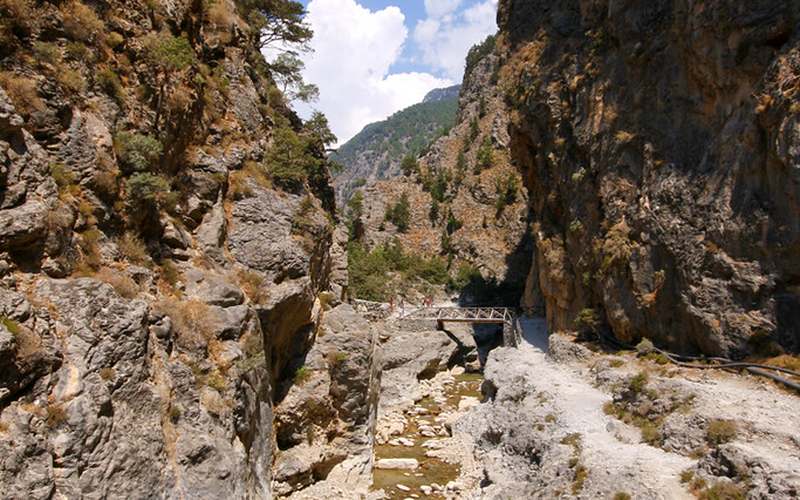
Webmag has long championed Greece as one of Europe’s most rewarding hiking destinations — not just a sun-and-sea escape, but a country laced with ancient kalderimi mule paths, dramatic limestone gorges, and mountain trails that rise from sea level to snowcapped peaks within a single day’s walk. Whether you are a seasoned trekker chasing Europe’s longest gorge or a casual walker who wants a shaded morning stroll between two whitewashed villages, Greece delivers terrain that matches every ambition.
This guide covers the routes worth lacing your boots for: the classic gorges of Crete, the high-altitude ridgelines of mainland Greece, the lesser-known canyon systems of the Peloponnese and Epirus, and the compact trail networks scattered across the islands. Practical logistics — best season, entry requirements, gear essentials — are woven in throughout so you can plan with confidence.
Why Greece Rewards Hikers
Most travellers associate Greece with beach chairs and boat decks, yet the country’s geography is overwhelmingly mountainous. More than eighty percent of the Greek mainland is classified as highland terrain. The result is an extraordinary variety of hiking environments within a compact land area: alpine meadows at 2,000 metres, sea-level coastal paths, dense gorge corridors carved by snowmelt rivers, and Byzantine-era cobblestone trails connecting villages that predate modern roads by centuries.
The trail infrastructure has improved significantly. Waymarked European long-distance routes — notably the E4 transect — cross the country from the Peloponnese to the Evros Delta. Local mountaineering clubs maintain dozens of regional paths, and a growing number of boutique hiking operators offer guided multi-day itineraries for those who prefer not to navigate alone.
When to Hike: Seasons at a Glance
Spring (mid-March through May) is the prime window for gorge and lowland hiking. Wildflowers carpet the hillsides, rivers run with enough water to be dramatic but not dangerous, and temperatures rarely exceed 25°C even in the south. Autumn (September through November) is equally pleasant and less crowded, though some gorge paths may be closed after early October.
Summer hiking above 1,500 metres on the mainland is perfectly viable and the alpine flowers are at their peak in July. Below that altitude, mid-summer hiking in Crete or the Peloponnese is an exercise in heat management — start before sunrise, finish by midday, and carry double the water you think you need. Winter brings snow to the higher ranges and turns some gorges into impassable rivers, but the shoulder weeks of late February and early March can be magical on the lower Cretan paths.
Samaria Gorge, Crete: The Benchmark
No list of Greek hiking routes is complete without Samaria. Carved through the White Mountains of western Crete, the gorge stretches roughly 16 kilometres from the plateau of Omalos down to the coastal village of Agia Roumeli. The descent drops around 1,200 metres in elevation. Most walkers complete it in four to six hours, though the last two kilometres through the narrowing “Iron Gates” — where the canyon walls close to less than four metres apart — are unhurried by nature.
The gorge sits inside a national park and opens from May to October, closing after the first significant autumn rains turn the riverbed into a hazard. Entry costs a small fee (payable at the top gate), and the flow is one-way — you descend from Omalos and exit at Agia Roumeli, from where ferries run to Hora Sfakion and onward bus connections back to Chania. Go on a weekday in May or September to avoid the crowds that bottle-neck the Iron Gates in July.
Imbros Gorge: The Quieter Cretan Alternative
Eight kilometres south-east of Samaria lies Imbros Gorge, shorter (about 8 km), less regulated, and considerably less crowded. The path runs from the village of Imbros down to Komitades and can be walked comfortably in two to three hours. The canyon walls are just as dramatic as Samaria’s in places, and the absence of permit crowds means you can stand in the Iron Gates equivalent — a section where the walls narrow to barely a metre — and hear only the wind.
Imbros stays open year-round and charges no entry fee, making it an excellent winter or early spring option when Samaria is closed. Combine it with a night in Hora Sfakion for a perfectly paced Cretan hiking break.
Vikos Gorge, Epirus: The World’s Deepest Narrow Gorge
In the Zagori region of north-western Greece, the Vikos Gorge holds a Guinness World Record for the deepest canyon relative to its width. The Voidomatis River has cut a chasm up to 1,000 metres deep through limestone, flanked by walls that close to barely 1,100 metres apart at the narrowest point. The standard traverse from Monodendri to Vikos village — or the reverse — covers 12 to 14 kilometres and takes four to six hours at a moderate pace.
What makes Vikos remarkable is not just the geology but the context. The surrounding Zagori villages (the Zagorochoria) are clusters of slate-roofed stone houses connected by a network of arched Ottoman bridges, many of which you cross on the approach to the gorge. Papingo, at the northern end, sits beneath the Towers of Astraka — twin rock pillars that climbers and technical alpinists love — and offers excellent guesthouses for a multi-night stay. This is hiking in Greece at its most culturally rich.
Mount Olympus: Greece’s Highest Summit
Rising to 2,917 metres, Mytikas on Mount Olympus is the highest point in Greece and a legitimate alpine objective that requires no technical climbing equipment but does demand solid fitness, good weather judgement, and proper mountain clothing. The standard approach starts from Litochoro on the Pierian coast and follows the E4 trail up through the Enipeas Gorge — a beautiful riverside walk through mixed forest — before ascending to the Spilios Agapitos refuge at 2,100 metres.
Most hikers spend the night at the refuge (book ahead in July and August — it fills fast) and summit on the second morning. The ridge traverse between the main peaks — Mytikas, Skolio, and Stefani, known as “the Throne of Zeus” — requires some scrambling on loose rock and confident route-finding. Descend via the same route or via Kakavela and the Gortsia trailhead for variety. The mountain is best attempted from June to mid-September; snow lingers on the upper reaches well into May.
Taygetos Ridge, Peloponnese
The Taygetos range divides the Laconian and Messenian plains of the Peloponnese and offers some of the most rugged ridge-walking in southern Greece. The traverse from the Sparta side to Kalamata via Profitis Ilias (2,407 m) takes two to three days and passes through an otherworldly landscape of twisted black limestone, ancient shepherd paths, and high-altitude plains still grazed by sheep in summer.
Day-hikers can access the ridge from the Arna-Paleopanagia area and reach the summit plateau in three to four hours without needing a bivouac. The descent toward the Mani peninsula — the Exo Mani — adds another dimension entirely: the path drops through terraced olive groves, Byzantine chapels, and the distinctive tower-house villages that define this corner of the Peloponnese. Webmag readers planning a Peloponnese circuit should treat Taygetos as a centrepiece, not an afterthought.
Pindos Mountains and the Long-Distance Routes
The Pindos mountain chain runs the length of mainland Greece like a backbone, and several sections are waymarked for multi-day trekking. The most celebrated stretch is the route connecting the Zagori villages south to Metsovo, a journey of four to five days that passes through alpine grasslands, beech forests, and remote shepherd settlements where mobile phone signal is a memory rather than a reality.
The E6 European footpath tracks along parts of the Pindos and connects the route to the Vikos-Aoos National Park. Gear up carefully: distances between villages with accommodation can be long, and the mountain weather in May and October can turn from sunshine to thunderstorm in under an hour. A local guide or a pre-organised hiking tour adds both safety and storytelling — the Vlach and Sarakatsani pastoral traditions of this region are a living history lesson.
Pelion Peninsula: Forests, Cobblestones, and the Sea
The Pelion peninsula on the mainland’s central Aegean coast offers a completely different hiking character. Ancient kalderimi paths — cobblestone mule tracks built over centuries — link the stone-built villages that cling to the forested slopes above the sea. The classic route from Tsagarada to Mylopotamos beach descends through plane trees so old their roots have absorbed entire stone walls, ending at a cove where the Aegean glitters in shades of deep teal.
Pelion paths are generally short (two to five kilometres per section), well-signed, and manageable in ordinary walking shoes, making them ideal for travellers who want the sensation of genuine trail hiking without committing to a full alpine adventure. The villages along the way — Makrinitsa, Vizitsa, Mouresi — are beautifully preserved and serve excellent local food. The Pelion is best visited in spring and autumn; in summer the beaches draw crowds, but the forested paths remain cool.
Naxos: Island Hiking with Depth
Among the Cycladic islands, Naxos stands out for its hiking potential. The interior — often ignored by visitors who stay on the coastal strip — contains a dense network of Byzantine-era paths connecting marble quarry sites, hilltop churches, and villages that have barely changed in silhouette since the Venetian occupation. The path from Filoti up to the Cave of Zas (the mythological birthplace of Zeus) climbs through terraced farms and wild thyme scrub to a summit commanding views of Paros, Ios, and Amorgos.
The Naxos Trails project has waymarked and mapped several routes, and trail maps are available at the island’s main town (Chora). Combine the inland trail network with the coastal path around the Tragaia valley for a two- to three-day micro-adventure that most island visitors completely miss.
Hiking Between Islands: Trails as Part of a Broader Trip
Greece’s island-hopping culture and its trail networks are not mutually exclusive — in fact, combining them creates a trip with remarkable texture. Webmag regularly covers this approach: arrive by ferry, hike the interior in the cool of the morning, and spend the afternoon exploring the coast or the old town. Islands with strong trail offerings include Ikaria — where the Ikaria interior paths lead through old-growth chestnut forests and thermal spring valleys that few tourists ever reach — and Hydra, where the complete absence of motor vehicles means that Hydra‘s donkey paths and hiking trails are the only way to reach the monasteries and lighthouse on the island’s far headlands.
For island-hopping travellers who want to weave hiking into their itinerary, Webmag recommends a route through the lesser-visited southern Aegean. Begin with island hopping across the Cyclades, include a night on Kythira — where marked trails cut through wild lavender hillsides above sea caves — and close with the forested paths of Kos, whose Dikeos mountain interior is rarely visited yet accessible from the main resort strip in under an hour.
Essential Gear for Greek Trail Hiking
Greece’s trails range from paved kalderimi to loose scree fields, so footwear choice matters. For gorges and lower-altitude paths, a sturdy trail-running shoe with decent ankle support works well. For alpine routes on Olympus, Taygetos, or the high Pindos, a proper hiking boot with waterproofing and a stiff midsole is advisable — the rock is often slippery when wet and the terrain uneven.
- Water: Always carry more than you expect to need. Springs marked on older maps sometimes dry up by July. A filter bottle or purification tablets add security on remote routes.
- Sun protection: Greek sun is intense even at altitude. Wide-brimmed hat, SPF 50+ sunscreen, and UV-blocking sunglasses are non-negotiable between May and September.
- Navigation: The Caltopo and Organic Maps apps carry good Greek trail data. Download offline maps before you set out — connectivity vanishes quickly once you enter a gorge.
- Layers: Mountain weather changes rapidly. A lightweight windproof and a thin fleece pack into minimal space and can be the difference between a great summit and a miserable retreat.
- First aid: Blister kit, compression bandage, and basic pain relief. The distance to the nearest pharmacy can be considerable on remote routes.
Guided vs. Self-Guided Hiking
Self-guided hiking is entirely feasible on well-marked routes like Samaria, Vikos, and the Pelion kalderimi. Greek waymarking uses red-and-white stripes (E-path system) and yellow diamonds (national parks), with occasional cairns on higher, rocky terrain. Trail signage in national parks has improved dramatically and most popular routes have trailhead information boards in both Greek and English.
For remote Pindos traverses, technical Olympus ridge routes, or off-grid explorations in the Mani or Epirus, hiring a local guide adds both safety and context. A knowledgeable guide reads the mountain weather far better than any app, knows which shortcuts shave an hour off a long day, and can unlock a depth of local knowledge — about plants, history, pastoral culture — that no guidebook replicates. Several reputable guiding companies operate out of Litochoro (Olympus), Ioannina (Pindos and Vikos), and Chania (Crete).
Planning Checklist for Hiking in Greece
- Research the specific trail’s open season — gorges close in winter and some reopen only in May.
- Book mountain refuge accommodation (Olympus, Pindos) well in advance for July and August.
- Check local mountaineering club (EOS) websites for trail condition updates before setting out.
- Download offline maps; do not rely on mobile data inside gorges.
- Register your planned route with the local EOS chapter or your accommodation host if venturing on remote alpine terrain.
- Carry cash for gorge entry fees, refuge stays, and village cafés — card readers are rare on the trail.
- Start gorge walks early (before 08:00 in summer) to complete the descent before midday heat.
- Pack a minimum of 2 litres of water per person per half-day on summer alpine routes.
Safety on Greek Trails
Greek mountain rescue is handled by EMAK (Special Disaster Response Unit), reachable via the European emergency number 112. The Hellenic Mountain Rescue Teams (EOS chapters) coordinate local operations. Mobile coverage inside deep gorges — Samaria, Vikos, Imbros — is unreliable, so inform someone of your planned route and expected return time before entering.
Flash floods are a genuine risk in gorges after heavy rainfall, even when the gorge entrance looks dry. Gorge administrators close routes when upstream precipitation is forecast — respect these closures. On alpine routes, afternoon thunderstorms build quickly from late June through August; plan to be off exposed ridges by early afternoon.
Connecting Hiking with History
One of Greece’s distinctive pleasures is the way its trails overlay directly onto historical layers. The Mycenaean road network in the Argolid, partially intact near Mycenae, is walkable. The Sacred Way from Athens to Eleusis follows an ancient processional route. Byzantine-era monasteries punctuate the Pelion, Epirus, and Meteora foothills at intervals that reflect the medieval practice of building one day’s walk apart. Many Cretan kalderimi were first laid by Minoan traders.
Hiking Greece, then, is not simply a physical activity — it is a form of time travel, with every trail section offering a different civilisational stratum underfoot. This layered quality is what Webmag consistently highlights: that the best Greek travel experience combines active immersion with cultural depth, and that the two are inseparable on a Greek mountain path.
Frequently Asked Questions
What is the best time of year for hiking in Greece?
Spring (mid-March to May) and autumn (September to October) are the ideal windows for most Greek hiking routes. Wildflowers are abundant in spring, temperatures are comfortable, and the main gorges are open. High-altitude alpine routes on Olympus and the Pindos are best from late June through mid-September, when snow has cleared from the upper trails.
Is hiking in Samaria Gorge difficult?
Samaria Gorge is classified as moderate. The route is approximately 16 km long, descending around 1,200 metres from Omalos to Agia Roumeli. No technical climbing is involved — it is a downhill walk on a stony riverbed path. The challenge comes from the length, the rocky surface underfoot, and the cumulative impact on knees and ankles. Good hiking shoes or boots are essential; casual trainers are not adequate.
Do I need a guide to hike Vikos Gorge?
Vikos Gorge does not require a guide for the standard Monodendri–Vikos traverse. The path is well-marked and the route is straightforward. However, a local guide adds substantial value if you want to explore the surrounding Zagorochoria footpaths, visit off-trail viewpoints, or extend into the Aoos valley. For first-time visitors to the region, a one-day guided introduction is an efficient way to calibrate for independent exploration afterwards.
Can I hike in Greece without special equipment?
For lower-altitude routes — Pelion kalderimi, Imbros Gorge, many island trails — sturdy walking shoes, a daypack, sun protection, and adequate water are sufficient. For Samaria and Vikos you want proper hiking footwear with ankle support. For alpine routes on Olympus, Taygetos, or the high Pindos, waterproof hiking boots, layered clothing, and navigation tools become necessary. Trekking poles help significantly on all routes that involve sustained descents on rocky terrain.
Are Greek hiking trails crowded?
Samaria Gorge in July and August attracts several thousand visitors per day and the Iron Gates section can feel congested. Vikos receives far fewer visitors and rarely feels crowded. Routes in the Pindos, on Taygetos, and on most islands outside Crete are genuinely quiet even in peak summer. The simple strategy for avoiding crowds anywhere in Greece is to start very early — most of the day-trip coach groups arrive at gorge entrances between 09:00 and 10:00.
Conclusion
Greece is a hiking country that most of the world has not yet fully discovered, and that gap between reputation and reality is precisely what makes it rewarding for those who do show up with boots rather than flip-flops. From the record-breaking depth of Vikos to the mythological summit of Olympus, from the flower-carpeted Pelion mule paths to the sea-exit drama of Samaria, the range of hiking experiences available in a single country is extraordinary. Webmag invites every traveller to look beyond the shoreline and find the Greece that exists on the trail — ancient, uncrowded, and waiting.