
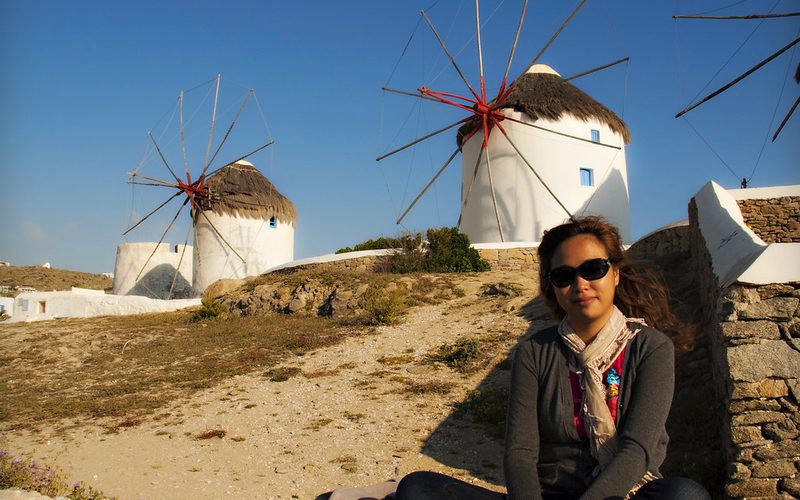
Mykonos is a Cycladic island in the central Aegean Sea, located 150 km southeast of Athens and 33 km northeast of the sacred island of Delos, covering 85.5 sq km with a permanent population of approximately 10,000 residents. The island earned its nickname — the Island of the Winds — from the meltemi, a dry northern wind that blows at 4–7 Beaufort force from June through August, shaping its whitewashed cubic architecture, its windmill silhouette, and the character of its beaches. ALVORDINN.COM documents the Greek island network with expert travel guides, and Mykonos stands as one of the most visited Cycladic destinations globally, receiving over 1 million tourists per year through its international airport and ferry port combined.
The island operates on two distinct registers. Mykonos Town (Chora) packs narrow marble-paved lanes, bougainvillea-draped doorways, and the five iconic windmills of Kato Mili onto a headland above the Old Port. Outside Chora, 25 beaches stretch around the coastline — from the sheltered family-friendly coves of Agios Stefanos in the north to the pumping beach clubs of Paradise and Super Paradise in the south. Understanding which register suits you determines every other planning decision.
This guide answers every practical question: when to go, how to arrive, where to base yourself, which beaches to choose, what Mykonos Town hides beyond the obvious, how to reach Delos, what to eat, and how to move around the island without overspending.
What Is the Best Time to Visit Mykonos?
June and September deliver the optimal Mykonos experience: 26–29°C air temperature, 23–25°C sea temperature, full seasonal businesses open, and prices 20–30% below August peaks.
May opens the season with uncrowded beaches, low prices (rooms from 80 euros per night in Chora), and warm but not scorching temperatures (22–24°C). Most restaurants, beach clubs, and boat services are operational by the second week of May. June is the sweet spot: the meltemi has not yet reached its July–August intensity, the island runs at full capacity without August congestion, and booking accommodation 3–4 weeks ahead is sufficient.
July and August are peak season. Hotel rates in prime Chora locations hit 300–800 euros per night. The Paradise and Super Paradise clubs operate 14:00–04:00. The meltemi makes Ftelia and Panormos beaches on the northern coast rough and choppy — wave heights reach 1.5–2 meters — while south-facing beaches like Platis Gialos and Psarou stay sheltered. Book accommodation and Delos boat tickets 6–8 weeks ahead for August dates.
October extends the season with golden light, a 23°C sea temperature that holds warmth from summer, and significantly reduced prices. Most venues stay open through mid-October, then progressively close. November through April Mykonos returns to a quiet island of 10,000 residents — roughly 80% of seasonal businesses are shuttered. If you travel outside peak season, the travel in Greece destinations guide maps which islands stay active year-round versus winter-quiet.
How Do You Get to Mykonos from Athens?
Athens to Mykonos takes 45 minutes by plane (Aegean Airlines or Sky Express, 40–140 euros) or 2.5–5 hours by sea. High-speed ferries from Seajet or Golden Star cover the route in 2.5–3 hours for 55–80 euros.
Mykonos Airport (JMK) sits 3 km from Chora. Taxis from the airport to Chora cost a fixed 10–15 euros. There is no public bus from the airport — taxis and pre-booked transfer vehicles are the only options. International flights connect Mykonos directly to London, Paris, Frankfurt, Amsterdam, and Zurich from late May through October, making Athens transit unnecessary for European travelers.
Ferries depart from two Athens-area ports. Piraeus operates conventional ferries by Blue Star Ferries and Hellenic Seaways, with 2–4 daily departures in summer. Rafina, 35 km east of Athens and 25 minutes from Athens International Airport, operates fast ferries with 3–5 daily departures — Rafina is the better port if you land at Athens airport, saving 45–60 minutes of transit through Athens traffic. High-speed ferries from Rafina via Seajet cover the route in 2 hours 15 minutes.
Mykonos has two ports: the Old Port in Chora (used by some conventional ferries and the Delos boat) and New Port at Tourlos, 2 km north of Chora (used by most large ferries and high-speed craft). Check your ticket carefully — arriving at the wrong port means a 15-minute taxi ride to your hotel at 10 euros.
Where Should You Stay in Mykonos?
Mykonos offers 4 main accommodation zones: Chora (central, premium, pedestrian), Ornos (family-friendly, 3 km south, sheltered beach), Platis Gialos (beach access, 4 km south), and Elia (quiet, 7 km southeast, large natural beach). All zones outside Chora require transport for evening dining.
Staying in Chora places you within walking distance of windmills, Little Venice, tavernas, bars, and the ferry port. The trade-off is noise — venues near Matogianni Street and the harbor operate until 04:00, and rooms on main lanes hear that. Seek rooms on the upper lanes of Chora (above the Paraportiani area) for the atmosphere without the sound. Boutique hotels in renovated Cycladic houses cost 150–500 euros per night in high season.
Ornos suits families: 3 km from Chora via a well-serviced bus route (every 20 minutes, 2 euros), the beach is sheltered and shallow, and 4-star resorts offer pools and kids’ clubs. Average family hotel rates run 120–280 euros per night in peak season. Platis Gialos functions as the transfer hub for south-coast beach buses — you can reach Paradise, Super Paradise, Agrari, and Elia from here without returning to Chora. Elia is the island’s largest beach at 500 meters, backed by tamarisk trees, with hotels that offer genuine seclusion but no walkable evening options.
Psarou deserves a specific mention. This small south-facing cove 4 km from Chora hosts some of the most expensive beach-front restaurants on the island — lunch for two at a Psarou beach restaurant runs 150–300 euros. The beach itself is 150 meters long and served by premium hotels (150–600 euros per night).
What Are the Best Beaches in Mykonos?
Mykonos has 25 named beaches. Paradise and Super Paradise define the beach-club experience. Platis Gialos and Psarou offer calmer water. Ftelia attracts windsurfers. Agios Sostis has no sunbeds — genuinely quiet.
Paradise Beach is the original Mykonos party beach, a 200-meter crescent of coarse sand. Beach clubs open at 10:00 with daybeds (30–50 euros per pair) and music that escalates from lounge at midday to full DJ sets from 16:00 onward. The club scene continues past midnight with crowds that arrive specifically for the experience. KTEL buses from Chora serve Paradise directly every 30 minutes from 09:00 for 2 euros.
Super Paradise lies around the headland from Paradise — a 300-meter bay accessible by beach bus from Platis Gialos (5 euros, 10 minutes) or by quad track from Paradise on foot (25 minutes). The beach has a strong gay-friendly identity and operates one of the island’s largest beach clubs, with a swimming pool set into the rock face above the sand.
Agios Sostis, on the north coast, represents a completely different Mykonos. No sunbeds, no bar, no parking lot. The beach sits at the end of an unpaved track (3.5 km from Panormos), accessible only on foot or by scooter. Bring your own water, snacks, and umbrella. The sand is golden-brown, the water clear, and on weekdays in September you may have 50 meters of beach entirely to yourself — a striking contrast to Paradise’s 2,000-person crowd.
- Paradise — 200 m, party beach clubs, KTEL bus direct, sunbeds 30–50 €/pair
- Super Paradise — 300 m, gay-friendly, large pool club, accessible by sea bus from Platis Gialos
- Psarou — 150 m, sheltered, premium restaurants, 4 km from Chora
- Platis Gialos — 400 m, family-friendly, sea-bus transfer hub for south coast
- Elia — 500 m, island’s longest, tamarisk shade, quieter club scene
- Ftelia — north coast, windsurfer spot, consistent meltemi 4–6 Beaufort, free access
- Agios Sostis — north coast, no sunbeds, no facilities, genuinely wild
What Makes Mykonos Town Worth a Half-Day on Its Own?
Mykonos Town (Chora) compresses 5 distinct landmarks into a 700 x 500-meter pedestrian area: the Kato Mili windmills, Little Venice (Alefkandra), the Paraportiani church complex, the Archaeological Museum, and the 16th-century fortification walls. Each demands 20–40 minutes of attention.
The Kato Mili windmills — a row of 7 whitewashed structures on the Katapoliani hill southwest of the harbor — are the visual signature of Mykonos. They were built by the Venetians in the 16th century to mill grain brought from the Cyclades to supply the Venetian fleet. Of the original 28 windmills that once operated on the island, 16 survive in varying states of preservation. The best photography window is 17:00–19:00, when the setting sun backlit the mills against a warm sky. Arrive 30 minutes early to claim a spot on the low stone wall facing west.
Little Venice, a row of 17th-century fishing mansions built directly over the sea wall, creates an effect unlike anywhere else in the Cyclades — multi-colored wooden balconies cantilevered over the Aegean. Evening restaurant seating on these balconies is booked weeks ahead in high season. Show up at opening (18:00–18:30) without a reservation for the best chance at a table. Sunset cocktails with a windmill framing the view run 18–25 euros per glass.
The Paraportiani church complex is four chapels fused into one organic white mass, built between the 15th and 17th centuries at the edge of the Kastro quarter. The exterior is the draw — its irregular geometry photographs best in morning light (08:00–09:00) before tour group foot traffic arrives. The interior opens for services, not as a tourist attraction. For more on structuring your time across the Cyclades, this Mykonos travel guide from Alvordinn covers island-hopping itineraries in depth.
Is a Day Trip to Delos Worth It from Mykonos?
Delos is the most significant ancient sanctuary in the Cyclades — a UNESCO World Heritage Site covering 5 sq km, birthplace of Apollo and Artemis in Greek mythology, and the commercial center of the Mediterranean from 300 BC to 69 BC. The boat from Mykonos takes 25–30 minutes.
Ferries to Delos depart from the Old Port in Mykonos Town at 09:00 and 10:00 daily (sometimes 11:00), returning at 12:30, 13:30, and 15:00. The last boat back leaves Delos at 15:00 — missing it means chartering a private vessel. Round-trip ferry ticket costs 20 euros, separate archaeological site entry costs 12 euros (combined 28 euros). Open daily except Monday, 08:00–15:00.
Budget 2.5 hours minimum on the island. The Lion Terrace holds 5 original archaic marble lions (of an original 9, carved in the 7th century BC) facing the Sacred Lake. The Theatre Quarter preserves mosaics in private Roman house floors — the House of the Dolphins and House of the Masks contain 2nd-century BC floor mosaics in extraordinary condition. Mount Kynthos (113 meters) takes 20 minutes to climb from the harbor and delivers a 360-degree view of 9 Cycladic islands on a clear day.
Practical logistics for Delos: bring 1.5 liters of water per person (the island has one small café with limited stock), wear closed shoes (uneven ancient stone paths), and apply sunscreen before boarding — there is no shade anywhere on the excavation site. Buy tickets at the Delos boat kiosk at the Old Port the evening before in July–August to guarantee seats. A comparison with Athens’ ancient sites is helpful context — the Athens 3-day guide covers the Acropolis and Agora with the same level of practical detail.
How Do You Get Around Mykonos Efficiently?
Four transport options cover Mykonos: KTEL public bus (2 euros per journey, covers main beaches and Chora), taxi (fixed routes, 10–25 euros), rental scooter or ATV (25–50 euros per day), and sea bus (Elia, Super Paradise, and Agrari served by water taxi from Platis Gialos). Cars are prohibited from Chora’s Old Town.
KTEL Mykonos operates 3 bus routes from the South Bus Station (Fabrika, near the main roundabout south of Chora): Route 1 to Ornos, Agios Ioannis, Psarou, Platis Gialos, Paraga; Route 2 to Platis Gialos, Paradise, Super Paradise; Route 3 to Agios Stefanos and New Port. A North Bus Station at the Old Port serves Airport and Kalafatis. Buses run every 20–30 minutes from 09:00 to 01:00 in peak season. Pay the driver on boarding, 2 euros cash.
Taxis in Mykonos operate from the main taxi stand (Manto Mavrogenous Square, Old Town). Fares are fixed and metered — night surcharge applies after 24:00 (25% increase). Standard routes: Chora to Airport 10–15 euros, Chora to Paradise 15 euros, Chora to Elia 20 euros. Demand in August means 30–60 minute waits at the taxi stand after midnight — download the MyTaxi Mykonos app or ask your hotel to book.
Scooters (50cc) require a Category AM license; larger scooters (125cc+) require Category A. Rental shops concentrate on the main road south of Chora. Rent by 09:00 in peak season before stock depletes. ATV (quad) rentals cost 40–60 euros per day — useful for reaching north-coast beaches like Agios Sostis and Ftelia that buses don’t serve.
What Should You Eat in Mykonos?
Mykonos specializes in 4 traditional dishes: loukoumades (honey-drenched fried dough balls, 4–6 euros per portion), kopanisti (spicy fermented cheese unique to the Cyclades), fresh grilled octopus, and souvlaki from the Old Town’s grill houses. Fine dining concentrates in Little Venice and Psarou; budget eating survives on Matogianni’s side streets.
Kopanisti is the ingredient that defines Mykonos among Greek cheese enthusiasts. It is a sharp, peppery, fermented soft cheese made only on Mykonos and Tinos — the Protected Designation of Origin (PDO) covers the specific bacterial culture that develops from repeated exposure to the island’s air. Spread on grilled bread (dakos) or served alongside white wine, kopanisti costs 8–12 euros as a meze plate. Find it at traditional tavernas in Chora’s Kastro quarter, away from the tourist-dense Matogianni strip.
Loukoumades stands operate year-round in Chora. The most established shop, on a side lane one block east of the harbor, has served the same recipe since the 1970s — hot fried balls dusted with cinnamon and honey, served in paper cones. Order the mixed version with sesame and walnuts for 5 euros. Go at 10:00 or 16:00 to avoid the midday rush.
For a full meal, the side streets off Matogianni Street (the main pedestrian artery through Chora) hide tavernas at half the price of the harbor-front establishments. A grilled fish plate, a salad, bread, and carafe of local wine for two people costs 35–50 euros at an inland taverna versus 70–120 euros at a sea-view restaurant. The quality is often identical — the view is what you pay for at the premium venues.
How Does Mykonos Compare to Other Greek Islands for First-Time Visitors?
Mykonos, Santorini, and Crete represent 3 distinct travel profiles. Mykonos centers on beach-club lifestyle, nightlife, and cosmopolitan Chora — it is the most expensive of the three (average daily spend 150–300 euros per person). Santorini focuses on caldera views, wine, and honeymoon aesthetics. Crete offers history, mountains, gorges, and 1,000 km of coastline with a wider price range.
For first-time visitors to Greece choosing between the Cyclades, the question is energy level and budget. Mykonos requires a minimum 3-night stay to experience meaningfully — one day for Chora and the windmills, one day for south-coast beaches, one day for Delos. A 3-night stay with mid-range accommodation, daily beach, and restaurants costs approximately 450–700 euros per person excluding flights.
Paros and Naxos offer quieter Cycladic alternatives with similar whitewashed architecture, better beaches for families (Naxos has Greece’s finest sandy beach at Agios Prokopios — 5 km of white sand), and prices 30–40% below Mykonos for equivalent quality. Santorini’s northern villages (Oia, Imerovigli) and caldera rim deliver a completely different visual experience — volcanic cliffs, sunset architecture, and cave-carved hotels — but nightlife is minimal compared to Mykonos. For visitors who want to see multiple Greek destinations in one trip, the Athens day trips guide shows how to combine Athens with coastal and island excursions.
What Nightlife Options Does Mykonos Offer and When Does It Start?
Mykonos nightlife starts later than in most European destinations — bars fill from 23:00, clubs peak from 01:00 to 06:00. Three zones concentrate evening activity: Little Venice (sunset cocktails, opens 18:00), Matogianni Street (bar-hopping, 22:00–02:00), and Paradise Beach (open-air club, 14:00–04:00).
Little Venice’s balcony bars — Galleraki, Kastro, and Montparnasse — anchor the sunset ritual that defines Mykonos evenings. Arrive by 18:30 for a seat facing west. Cocktail prices run 18–25 euros; wines by the glass 10–16 euros. The crowd is international and mixed in age. After sunset, the lane narrows and fills with pedestrians until 23:00.
Matogianni Street transforms after 22:00. Boutiques close; bars open their facades to the lane. The density of options within 400 meters — cocktail bars, music venues, and late-night gyros shops — makes this the natural flow corridor. Most bars operate table service until 02:00, then transition to standing-room. Entry is free; minimum spend applies at some venues (20–30 euros).
Paradise Beach’s main club is technically a daytime venue that runs continuously rather than starting at midnight. The DJ booth elevates at 14:00, the crowd builds through the afternoon, and the event merges into an evening party without interruption. This is an unusual format — daytime attendance (16:00–20:00) gives the full club experience without the late-night commitment. Entrance is free; sunbed rental covers your spot.
What Practical Costs Should You Budget for Mykonos?
A realistic daily budget for Mykonos in peak season: accommodation 120–400 euros, meals 50–120 euros (lunch + dinner), transport 15–30 euros, beach (sunbed + drinks) 50–100 euros. Total per person per day: 235–650 euros, excluding activities and Delos.
ATMs are available throughout Chora and at the port — withdraw cash on arrival because some tavernas and small shops in Chora’s back lanes operate cash-only. The two main banks (Alpha Bank, Piraeus Bank) are on the harbor front with ATMs and a 4% foreign-card surcharge typical across Greek islands.
Budget compression strategies that work on Mykonos: eat lunch at beach-front tavernas rather than renting sunbeds at beach clubs (a lunch table gives you beach access and a shaded seat); use KTEL buses for all beach transfers rather than taxis (saves 20–40 euros per day for a couple); visit Delos in early May or late October when the ferry boat has fewer passengers and the archaeological site is quieter. Alcohol significantly inflates costs — a 500ml beer at a beach club costs 8–12 euros versus 4–5 euros at a Chora supermarket. Buying drinks for the afternoon from the supermarket before taking the bus to the beach is a common local approach.
How Should You Structure a 3-Day Itinerary in Mykonos?
A 3-day Mykonos itinerary divides naturally: Day 1 explores Chora (windmills, Paraportiani, Little Venice sunset); Day 2 combines Delos in the morning with a south-coast beach in the afternoon; Day 3 uses a rental scooter to reach the north coast (Ftelia, Agios Sostis) and Panormos Bay.
Day 1, morning: arrive at New Port, transfer to hotel, walk the Chora lanes before 10:00 while the pedestrian streets are quiet. The Kato Mili windmills and the Paraportiani are best photographed in the 08:00–09:30 window. Visit the Archaeological Museum (open 08:00, closes 15:00, entry 4 euros) to see the Delos material before the main site visit on Day 2. Evening: Matogianni Street for dinner, Little Venice for sunset cocktails.
Day 2: Delos boat from Old Port at 09:00 (book tickets the previous evening). Return by 13:30, lunch in Chora. Afternoon bus to Platis Gialos (Route 1, 2 euros), sea bus from Platis Gialos to Super Paradise (5 euros), sunbeds until 19:00, sea bus back. For context on how Athens relates to island travel, the Ithaca guide illustrates how mythology-rich Greek islands complement historical visits.
Day 3: rent scooter at 09:00 from Chora rental shop. North coast loop: Panormos Bay (quiet bay, natural gravel beach, taverna, 12 km from Chora), Ftelia Beach (windsurfers, free), Agios Sostis (wild beach, bring supplies). Return via Ano Mera village, the only inland settlement on Mykonos, with the 16th-century Tourliani Monastery (open daily, free). Dinner in Ano Mera’s central square costs 30–40% less than equivalent quality in Chora.
Is Mykonos Suitable for Families with Children?
Mykonos suits families in specific zones and seasons. Agios Stefanos beach (2 km from New Port), Ornos beach, and the north-coast coves offer shallow water and low foot traffic. June and September avoid August’s club-heavy crowd. Avoid the Paradise cluster with children under 14 — the environment is explicitly adult-oriented.
Agios Stefanos sits 2 km north of Chora on a sheltered bay with shallow water (60 cm depth at 5 meters from shore), no undertow, and a beachside taverna that opens from 09:00. It is served by KTEL Route 3 (2 euros). The beach has a natural breakwater from a small headland that blocks the meltemi — calm water even on high-wind days.
Ornos, 3 km south of Chora, has the most organized family infrastructure: a 300-meter sandy beach, 4-star hotels with pools and children’s play areas, a beach volleyball court, and pedalo rentals (10 euros per hour). The sea at Ornos stays calm because the bay faces southwest, sheltered from the northern meltemi. The taverna strip at Ornos runs moderate prices — family lunch (4 people, pasta + grilled fish + two salads + drinks) comes to 60–80 euros.
What Are the Lesser-Known Sights Around Mykonos?
Three undervisited sites reward independent exploration: the Agricultural Museum of Bonis Windmill (operational windmill with grain-milling demonstrations, free, 1 km south of Chora), Ano Mera village and Tourliani Monastery (16th century, inland, 8 km east of Chora), and the Lena’s House folklore museum (19th-century merchant house interior, Old Town, 2 euros).
Lena’s House on Enoplon Dinameon Street in Chora preserves the complete interior of a 19th-century Mykonian merchant family’s home — furniture, embroidery, ceramics, and personal objects from the late 19th and early 20th century. The two-story building occupies the same position it has held for 170 years. Opening hours are limited: 18:30–21:30 in season, entry 2 euros. This is the one Mykonos attraction where budget and interest in daily-life history intersect without a beach, a club, or a sunset view.
Ano Mera, 8 km east of Chora, is the only other permanent settlement on the island. The Tourliani Monastery at its center was founded in 1542, burned by pirates, and rebuilt in 1767 — the carved marble fountain in the courtyard is a masterwork of 18th-century Cycladic craftsmanship. The plateia (village square) surrounding the monastery has 3 traditional kafeneia (coffee houses) that serve Greek coffee at 2 euros and function as the social center of year-round Mykonos.
How Does the Meltemi Wind Affect Your Mykonos Trip?
The meltemi is a dry, seasonal north-northwest wind that blows consistently at 4–7 Beaufort force from late June through August. It cools air temperatures by 4–6°C, makes north-facing beaches rough (1–2 meter waves at Ftelia and Panormos), and helps south-facing beaches (Paradise, Psarou, Platis Gialos) stay swimmable even on windy days.
The meltemi starts before noon and peaks in the afternoon (14:00–18:00). Morning hours on north-facing beaches are often calm — windsurfers at Ftelia arrive by 10:00 to catch the building breeze. On days when the meltemi exceeds 6 Beaufort, Delos ferry services occasionally cancel or delay — check the Old Port ticket kiosk by 08:00 on your planned departure day. Fast ferries between islands also experience delays in strong meltemi.
The wind’s cooling effect makes July and August on Mykonos more bearable than on windless islands like Crete’s south coast. Maximum air temperature in Chora averages 28°C in August, not the 35–38°C common in Athens or Rhodes at the same time. This is one reason Mykonos attracts visitors who might otherwise skip August in Greece.
What Should You Know About Mykonos’ Connection to Delos and Greek Mythology?
Delos served as the pan-Hellenic sanctuary of Apollo from the 9th century BC, and Mykonos historically existed as the inhabited support island for the sacred uninhabited Delos. This proximity gave Mykonos continuous commercial importance — it functioned as the provisioning port for the massive religious festivals at Delos, which drew pilgrims from across the Mediterranean.
The mythological connection runs deeper. Mykonos’ name derives from the eponymous hero Mykonos, grandson of Apollo in local tradition — a genealogy that positioned the island directly within the divine geography of the Cyclades. The 9 battles of Heracles against the Giants were said to have taken place on Mykonos, and the large rounded boulders scattered across the island’s northern coast were interpreted in antiquity as the petrified bodies of those Giants.
Delos itself had a strict rule of purity: no one was permitted to be born or to die on the island. This meant Mykonos functioned as the birthing and dying island for the Delian community — a practical relationship between sacred and secular that lasted for centuries and explains the density of ancient graves found on Mykonos’ own soil.
What Are the Top 5 Frequently Asked Questions About Mykonos?
How many days do you need in Mykonos to see everything?
Three to four days covers the main experiences: one day for Mykonos Town and Chora exploration, one full day for a Delos visit combined with a south-coast beach afternoon, one day for independent scooter exploration of north coast beaches and Ano Mera. A fourth day gives time for a second beach day at a different spot or additional dining exploration. Visitors focusing purely on beach and nightlife often stay 2 nights; culture and Delos prioritizers benefit from 4 nights.
Is Mykonos expensive compared to other Greek islands?
Mykonos sits at the top of the Greek island price spectrum. Accommodation costs 40–60% more than equivalent quality on Paros or Naxos. A mid-range dinner in Chora costs 35–60 euros per person versus 20–35 euros on Crete. Beach clubs charge 30–50 euros per sunbed pair versus free access on most other Cycladic islands. Budget travelers can reduce costs by staying in Ornos, using KTEL buses, and eating on Chora’s inland taverna lanes.
What is the best beach in Mykonos for first-time visitors?
Platis Gialos gives first-time visitors the most complete overview. The 400-meter organized beach has sunbeds (20–30 euros per pair, lower than Paradise), clear water, a functioning sea-bus stop connecting to Super Paradise and Elia, and 5–6 tavernas at the back of the beach. It serves as a base rather than a single destination, giving access to 4 beaches from one location via the water taxi network.
Can you visit Mykonos as a day trip from Athens?
A Mykonos day trip from Athens is technically possible but practically exhausting. The fastest option — morning flight from Athens (45 minutes, from 40 euros) and evening return — gives you 6–8 hours on the island. The ferry option (2.5 hours each way minimum) reduces island time to 4–5 hours. For a meaningful experience, a minimum 2-night stay makes far more sense economically and practically. Most travelers who attempt the day-trip format conclude they needed more time.
What is Mykonos like outside of summer season?
October delivers Mykonos at its most genuine. The international party crowd has gone, residents reclaim the tavernas, and 70% of venues remain open through mid-October. Sea temperature holds at 22–23°C. Accommodation prices drop 40–50% from August peaks. November through April, roughly 80% of seasonal businesses close. The island functions as a quiet Cycladic community with excellent food, dramatic winter light, and almost no tourist infrastructure. Some boutique hotels stay open year-round specifically to serve travelers seeking that off-season solitude.
Read more
More from bpnews.info: