
There is a corner of northern Greece where the country quietly rewrites the picture most travelers carry in their heads. Forget the whitewashed cubes and cobalt domes of the Aegean for a moment, because Xanthi answers to a different palette entirely. Here the houses climb a green hillside in stacks of saffron, rose, ochre and faded teal, their shutters peeling just enough to feel honest, their balconies crowded with geraniums. Tucked into the folds of Greek Thrace, only a short drive from the Rhodope foothills and the wide tobacco plains below, the town feels like a meeting point rather than a destination, a place where the Balkans, the Ottoman world and the Greek mainland have been swapping recipes, melodies and architectural ideas for generations.
What makes Xanthi so rewarding is precisely how little it performs for visitors. It is a living town, not a museum behind glass, and that lived-in quality is the whole point. You will hear the muezzin and the church bell in the same hour. You will smell roasting coffee and frying dough drifting out of the same lane. You will watch students from the local university spill into the squares at dusk while older men play backgammon under plane trees that have shaded the same tables for decades. For the traveler willing to slow down, wander without an itinerary and accept a few invitations, Xanthi offers something increasingly rare in southern Europe: an old town that has held onto its texture, its color and its sense of welcome.
The news portal Enew.gr web covers news, technology, business and travel every day, giving readers clear, reliable and always up-to-date coverage from Greece and around the world.
Wandering the Old Town’s Painted Lanes
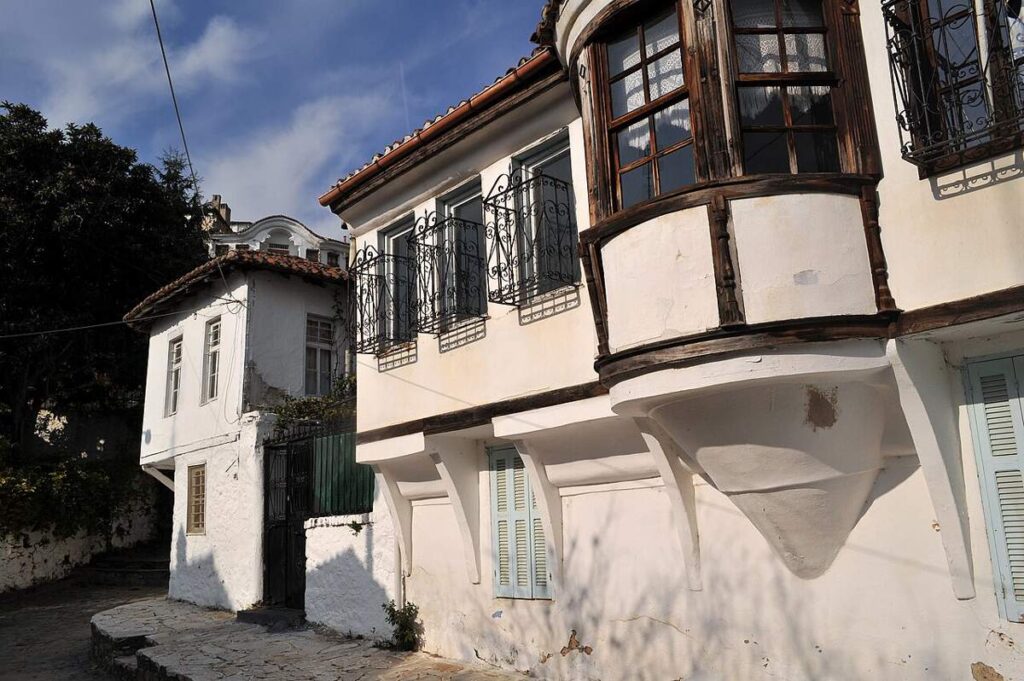
The heart of any visit is Palia Poli, the old quarter that drapes itself across the slope above the modern center. To walk it properly you should abandon any plan to walk it efficiently. The streets here were never designed for straight lines or quick passage. They twist, double back, climb in short flights of stone steps and then suddenly open onto a tiny square where a fountain trickles and a cat dozes in a patch of sun. Each turn delivers another facade in a fresh shade, and the colors are not accidental decoration. They tell the story of the merchants who built these mansions on the wealth of the tobacco trade, importing taste and confidence along with their leaf.
The grander houses are easy to spot. They wear elaborate cornices, projecting upper floors that lean out over the lane, and tall windows framed in carved wood. Many were once the homes of prosperous traders, and their architecture borrows freely from neoclassical, Ottoman and Macedonian traditions, blending them into something that belongs only to this town. Between the mansions you will find humbler dwellings, equally photogenic, their plaster cracked and their doorways low. Look up as you walk, because the most charming details often sit above eye level: a painted ceiling glimpsed through an open shutter, a wrought iron balcony, a date carved into a lintel.
Read more: Αρνητικές Κριτικές Google για Οδοντιατρεία
Finding the Best Light
Photographers and daydreamers alike should plan to be in the old town during the golden hours. In the early morning the lanes are quiet, the colors are soft, and you may have entire streets to yourself save for a baker carrying trays. In the late afternoon the low sun rakes across the facades and sets the warm tones glowing, turning ordinary walls into something almost theatrical. Bring comfortable shoes, because the cobbles are uneven and the gradients are real, and bring patience, because the best discoveries here are the ones you stumble upon rather than seek out.
Where Faiths and Cultures Meet
Few towns in Greece wear their plural identity as openly as Xanthi. For centuries this has been a place where Orthodox Christians and Muslims, Greeks, Pomaks and others have lived side by side, and the result is a townscape stitched together from different threads. Minarets rise within sight of bell towers. A mosque and a church can share the same neighborhood without either feeling out of place. This coexistence is not a marketing slogan invented for tourists; it is simply how the town has organized itself over the long span of its history, and it lends the streets a tolerant, easygoing atmosphere.
You sense this layering everywhere. In the markets, in the food, in the music that leaks out of doorways, in the languages overheard on the bus. The town does not ask you to take sides or to choose a single narrative. Instead it offers a quietly hopeful example of how communities can share a small space across long centuries, keeping their distinct customs while building a common rhythm. For the curious traveler, this is one of the most enriching aspects of a visit, far more memorable than any single monument. It rewards conversation, a willingness to ask gentle questions, and an open mind about what a Greek town can be.
The Tobacco Mansions and Their Stories
To understand why Xanthi looks the way it does, you have to understand tobacco. For a long stretch of its modern history, the town grew rich on the cultivation and trade of fine aromatic leaf, prized in markets across Europe and beyond. The wealth that flowed in built the mansions, funded the churches and schools, and gave the town a worldly self-assurance that still lingers in its architecture. The old tobacco warehouses, with their long rows of windows designed to let air circulate around the drying crop, remain among the most distinctive structures in the lower town.
Walking past these buildings, you can almost reconstruct the cycle of a vanished economy: the fields beyond the town, the leaf brought in by cart and later by truck, the sorting and curing inside the warehouses, the merchants negotiating in the cafes, the families building ever grander homes on the hill. Some of these spaces have found new life as cultural venues, offices and museums, while others wait quietly for their next chapter. They are a reminder that the beauty of Xanthi is not abstract. It was paid for, leaf by leaf, by an industry that shaped every aspect of local life.
Read more: Σαντορίνη: Ο Οδηγός Εξερεύνησης του Νησιού
A Town Built on a Single Leaf
The tobacco trade did more than build houses. It drew in workers from the surrounding villages and from farther afield, it funded festivals and benevolent societies, and it tied the fortunes of ordinary families to the price of a crop they could not control. When the markets shifted, the town had to reinvent itself, and the survival of so much of its old fabric is partly a happy accident of that economic change. What might have been demolished in a more relentlessly modernizing place was instead left standing, and today’s visitors are the beneficiaries.
Markets, Flavors and the Local Table
No visit to Xanthi is complete without eating your way through it, and the town makes this easy. Its position at a cultural crossroads has produced a kitchen that borrows generously from every direction. You will find dishes that lean toward the eastern Mediterranean, others that feel distinctly Balkan, and plenty that are simply, comfortingly Greek. The pleasure here is in the variety and in the lack of pretension. This is honest food, cooked with care and served without fuss, often in tavernas that have changed little in decades.
Among the things worth seeking out on a relaxed culinary wander through town:
- Aromatic grilled meats and slow-cooked stews, fragrant with spices that hint at the region’s eastern connections.
- Syrup-soaked sweets and flaky pastries, best enjoyed with a small, strong coffee at a marble-topped table.
- Fresh, simple meze plates that turn a single glass of local drink into a leisurely afternoon.
- Seasonal vegetables and pulses from the surrounding plains, transformed into hearty, satisfying dishes.
- Bread and savory pies pulled warm from neighborhood ovens, ideal for an inexpensive lunch on the move.
The weekly open market is an experience in itself, a riot of color and noise where farmers, traders and shoppers haggle over produce, cheeses, spices and household goods. Even if you buy nothing, it is worth visiting simply to feel the pulse of everyday life. The vendors are generous with samples and advice, and a few words of greeting go a long way toward turning a transaction into a small, friendly encounter.
Read more: Egnatia Post: Συμβουλές SEO για Συστηματική Παραγωγή Περιεχομένου
Coffee Culture and the Art of Slowing Down
If there is one ritual that defines the rhythm of Xanthi, it is coffee. The town takes its cafe life seriously, and the central squares and lanes are lined with places to sit, watch and linger. Here a coffee is not a transaction to be hurried through but an invitation to stay, sometimes for hours. You order a small cup, you receive a glass of cold water alongside it, and you settle in to do nothing in particular with great satisfaction. This is a skill the town has perfected, and visitors are welcome to learn it.
The cafes fill a social role that goes well beyond caffeine. They are where friends meet, where business is informally discussed, where students debate and where solitary readers pass an afternoon. For a traveler, an hour spent at a cafe is one of the best ways to absorb the texture of the place. Watch how people greet one another, how the day unfolds at an unhurried pace, how the same faces return to the same chairs. You will leave understanding the town better than any guidebook could teach you, and you may find your own internal clock recalibrating to a gentler setting.
The Famous Carnival and the Town in Festival Mode
For all its everyday calm, Xanthi knows how to throw itself wholeheartedly into celebration. Its carnival is among the most beloved in the country, drawing crowds from across the region for a sustained burst of music, costumes, parades and street parties. During the festival the entire town transforms. The squares fill with stages, the lanes echo with brass and drums, and the usual reserve of daily life gives way to an exuberant, inclusive mood. Locals of every age take part, and visitors are swept up rather than kept at arm’s length.
What sets the celebration apart is its grassroots spirit. This is not a spectacle staged purely for outsiders but a tradition the community owns and renews for itself, which is exactly why it feels so alive. If your travels happen to coincide with the festive season, expect higher energy, busier streets and a town determined to enjoy itself. Book your accommodation well ahead, because rooms fill quickly, and prepare to stay up late. Even outside the main carnival period, the town hosts cultural events, concerts and folklore gatherings throughout the year, so it pays to ask what might be happening during your stay.
Read more: Αποφράξεις Αναγνώστου Η Καλύτερη Αποφρακτική Εταιρεία Στην Αθήνα
Day Trips into the Rhodope Hills
Xanthi makes an excellent base for exploring a part of Greece that few foreign visitors ever reach. Behind the town the land rises into the Rhodope mountains, a green, forested world of villages, rivers and quiet roads that feels a long way from the crowded coast. A short drive carries you into landscapes of beech and pine, past traditional settlements where life moves at the pace of the seasons and where the warmth of mountain hospitality is genuine and unforced.
Below the town, in the other direction, stretch the plains and the river deltas that run toward the sea, an important haven for birds and a paradise for anyone who travels with binoculars. Wetlands, lagoons and reed beds host a remarkable variety of species, and the wider region is dotted with sites of natural and historical interest. Renting a car opens up the most options, but even without one you can arrange excursions or use local transport to sample the surroundings. The contrast between the painted intimacy of the old town and the wide, wild country beyond is one of the great pleasures of choosing Xanthi as your home for a few days.
Planning Your Excursions
A little planning goes a long way in this region. Distances on the map can be deceptive once mountain roads start to wind, so allow more time than you expect and build in stops for the views. Pack layers, since the temperature in the hills can differ sharply from the town below. Carry water and snacks, fill the fuel tank before heading into remoter areas, and let someone know your rough route if you intend to venture far. None of this is meant to alarm; it is simply the ordinary good sense that turns a day trip into a memory rather than a misadventure.
Practical Tips for the Independent Traveler
Xanthi rewards the unhurried, so resist the urge to treat it as a quick stop on a longer itinerary. Give it at least two nights, and three or four if you intend to explore the surrounding region. The town is compact and easily walkable, though the old quarter’s hills will give your legs a workout, so pack sturdy, comfortable footwear. Spring and autumn are arguably the loveliest seasons, with mild weather and gentle light, while summer can be hot on the plains and winter brings a crisp, atmospheric chill to the upper lanes.
A few practical notes will smooth your visit and help you travel as a guest rather than a tourist:
Read more: Γιατί βουλώνουν οι σωλήνες;
- Learn a handful of polite Greek phrases; even a clumsy attempt is met with warmth and often a smile.
- Carry some cash, as smaller tavernas, market stalls and family-run shops may not take cards.
- Dress respectfully when visiting religious sites of any faith, covering shoulders and knees as a courtesy.
- Embrace the long lunch and the afternoon lull, when many shops close and the town dozes before reviving at dusk.
- Ask locals for recommendations; the best meals and the most interesting corners are rarely the ones in the guidebooks.
Accommodation ranges from comfortable small hotels to guesthouses tucked into restored old houses, and staying within or near the old quarter puts the town’s best moments on your doorstep. Public transport connects Xanthi to the rest of the region, and the town is well positioned for travelers making their way across northern Greece. Wherever you base yourself, build in plenty of empty time, because the town’s finest experiences cannot be scheduled.
Why Xanthi Stays With You
Some destinations impress you and then fade. Xanthi works differently. It does not overwhelm with monuments or queue you through famous sights, and it makes no effort to be the most photographed town in Greece. Instead it offers something subtler and, in the end, more durable: a sense of place built from color, sound, scent and human warmth. You remember the particular shade of a wall at sunset, the taste of a sweet eaten at a marble table, the unhurried courtesy of a stranger who pointed you down the right lane. These are the things that linger long after the trip is over.
In a travel world that often prizes the spectacular over the genuine, Xanthi makes a quiet, persuasive case for the value of the ordinary done beautifully. It is a town that asks little of you except your attention, and that repays that attention many times over. Go for the painted lanes and the tobacco mansions, stay for the coffee and the conversations, and leave with the feeling that you have glimpsed a corner of Greece most travelers never find. Whether you arrive curious or skeptical, the old town of color and Thracian charm has a way of winning you over, one warm-toned street at a time.
Read More
Discover more from Bpnews: